US Ph : +1-647-955-3767
Call or Fax 9.30 to 5.30 pm
EST Mon to Fri.
EST Mon to Fri.


-
-
0Checkout
Your shopping cart is empty!
- Track Order
Finasteride and Minoxidil are two of the most popular and effective hair care treatments for hair loss. Both have been effective for various forms of hair loss, particularly androgenetic alopecia, but differ in mechanism of action, formulation, and results. Minoxidil is a popular topical drug; finasteride is an oral drug. But for those who want to effectively regrow their hair density and prevent hair loss, it can be difficult to choose between the two or decide whether to use them together. Finasteride Vs Minoxidil – It’s not an easy comparison, as it is contingent upon many factors, including the cause of hair loss, the age of the patient, and general health.
In this blog, we will cover their characteristics, risks, advantages, and the possibility of combining them to promote their effects. Is one better than the other? Or is the real secret in using them jointly? Find out below:
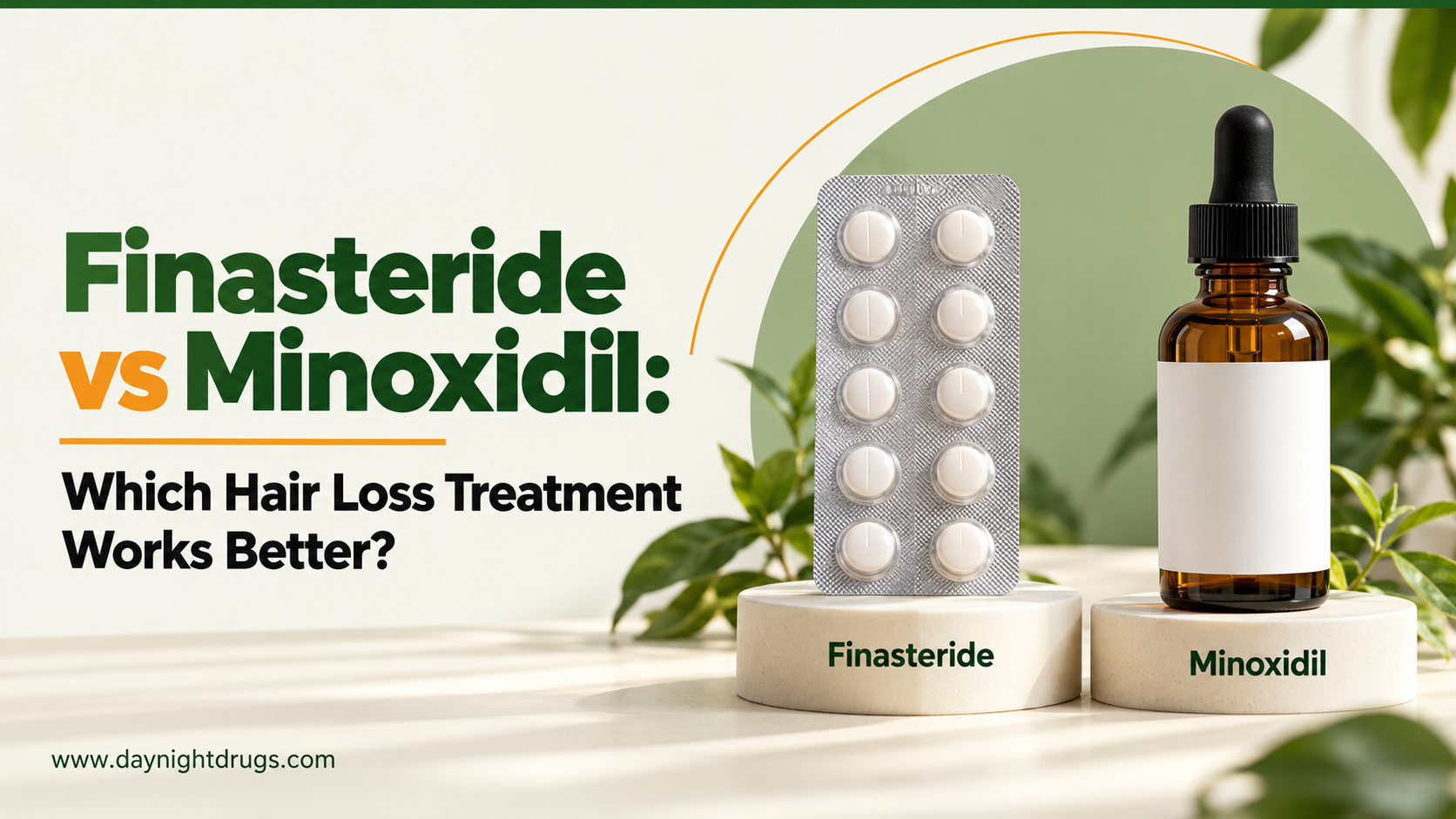
Finasteride is a prescription oral tablet medication. It’s mainly meant to combat men’s baldness by targeting the hormone responsible for hair thinning : dihydrotestosterone (DHT). If you use excess of this medication, DHT can cause hair thinning. By avoiding the testosterone conversion to DHT, this medicine stops the hair loss progression and starts promoting hair regrowth.
Finasteride blocks an enzyme called 5-alpha-reductase, which converts testosterone into a hormone called DHT. DHT can cause hair loss and prostate growth in men. By lowering DHT levels, finasteride may reduce prostate size and help hair to grow on the scalp. It may also elevate testosterone levels in the body. While DHT enhances beard and body hair growth, it can also lead to hair loss on the scalp.
Finasteride treatment for hair loss usually requires several months of regular use to show visible results. Most patients observed reduced hair loss within 3-6 months, while new hair growth can be visible between 6-12 months.
Although it has intended effects, Finasteride may cause some undesired effects. Normally, these side effects may not occur, but if they do, they may need medical attention. Check with your doctor immediately if any of the below-mentioned side effects occur:
More common
Cold sweats
Chills
Confusion
Faintness, dizziness, or light-headedness when getting up all of a sudden from a lying or a sitting position.Erectile dysfunction
Reduced sperm count
Erectile dysfunction
Reduced libido (sex drive)
Ejaculation issues
Less common
Breast enlargement and tenderness
Bloating or swelling of the arms, face, hands, feet or lower legs
Skin redness
Itching, hives or welts, skin rash
Tingling of the feet or hands
Unusual weight gain or loss
Serious side effects
Anxiety and depression
Allergic reactions such as rash, hives, itching, and swelling of the face and lips
Prostate cancer
Minoxidil is a hair loss treatment available as a foam or a topical solution. Originally developed as a blood pressure medicine, its hair-growth-stimulating properties were discovered by coincidence. This topical medicine functions by elevating blood flow to the hair follicles. This increases blood flow, which gives strength to dormant hairs, resulting in denser and much stronger hair. Whether you use the liquid or foam form, Minoxidil gives a ray of hope to those aiming for a non-hormonal and effective hair loss treatment.
Minoxidil opens adenosine triphosphate-sensitive potassium channels, which causes hyperpolarization of cell membranes. It opens potassium channels and expands blood vessels, so that more blood, oxygen, and nutrients can be infused to the follicles. It is a vasodilator, which means it enlarges the blood vessels to infuse more oxygen-rich blood to the hair follicles. Minoxidil is an antihypertensive medication that shows increased hair growth within 3-6 months. Once you stop the medicine, it has the tendency to return to its previous state.
Minoxidil is available in the following formats:
Lotion: Lotion is the most common form of the medicine, which is applied directly to the scalp.
Foam: Foam is an easier-to-use version and a lighter option for people with sensitive skin.
Tablets: Useful in specific circumstances under strict medical supervision.
Both topical and oral minoxidil deliver the same medicine to treat hair loss, but you may observe slight differences in their functioning—oral minoxidil vs. topical minoxidil.
Understand it below:
Oral minoxidil is a more convenient alternative that can help when the liquid doesn’t work well enough, while topical minoxidil is the FDA-approved, safe choice. Oral minoxidil is a once-a-day medication that works throughout your body.
It reaches follicles that topical minoxidil can miss. Topical minoxidil acts only on the scalp, so it carries a lower side effects risk. In head-to-head trials, the two are close on regrowth, so the best fit depends on your scalp and routine, the side effects you can accept, and your doctor’s advice.
Start with topical Minoxidil if:
You want the fewest whole-body effects
Your hair loss is early or mild
You don’t mind applying it twice a day
You prefer something you can buy over the counter
Consider oral, with a doctor, if
Topical didn’t work for you
You want a simple once-a-day tablet
The itching or the fiddly routine keeps breaking your consistency
You want the steadier delivery a once-daily tablet gives
Minoxidil's results timeline is not immediate. Patients typically observe minimized hair loss after 2-4 months of regular use. New hair growth is most apparent after the 6th month, with maximum results attained between 8-12 months. The effectiveness of the treatment is based on continuous use, as stopping may lead to hair loss.
Most minoxidil side effects are restricted to the skin. Beyond the skin, your body absorbs only small amounts of minoxidil. Because of this, whole-body side effects are uncommon. But they can happen in some instances, especially when minoxidil is used too much.
Common side effects
Hair loss
Irritation of the scalp
Dryness or flaky dandruff
Oily scalp or sticky residue
Hair color and texture change
Unwanted hair growth
Serious side effects
Chest pain
Light-headedness
Edema
Heart palpitations
Unnecessary weight gain
Trouble breathing
Allergic reaction symptoms such as rashes, extreme itching, or swelling.
?The branded version of finasteride is known as Propecia, while the branded version of minoxidil is known as Rogaine. Here is a comprehensive comparison of Propecia vs. Rogaine:
| Features | Finasteride | Minoxidil |
| How it Works | Stops hair loss | Works best for hair regrowth |
| Form | Available in oral tablet form | Available in lotion, foam, and tablets |
| Who it's for | Primarily for men | For both men and women |
| Time to results | Within 3-6 months | Within 3-6 months |
| Side Effects | Sexual dysfunction | Temporary hair shedding |
Finasteride (Propecia) successfully treats hair loss caused by male or female hair loss patterns by adjusting DHT levels that impact hair growth. Hair loss that isn’t caused by hormonal changes is often more responsive to Minoxidil (Rogaine). Typically, Finasteride is considered more effective than Minoxidil for men with male pattern hair loss. However, using Finasteride and Minoxidil jointly is mainly more effective than either treatment alone.
Finasteride is also effective in women experiencing female hair loss pattern or menopause-related hair loss. However, Finasteride should not be used by women who are in the menopause phase or those who are pregnant or want to become pregnant, as it can lead to fetal developmental issues. Finasteride can also affect birth control effectiveness.
Minoxidil is mainly effective for most women, but it should not be used by pregnant or breastfeeding women
Finasteride and Minoxidil together work through different mechanisms; if you use them together, it can give you a complete hair restoration solution. They are comparatively safe to use; it's always wise to stay vigilant. Monitor for any unusual symptoms, and always opt to consult a dermatology expert before changing your treatment option. After all, your hair journey is unique, thus giving you a customized approach.
Your perfect personal journey should be to restore your hair's former glory. While both Minoxidil and Finasteride have been successful in hair restoration, the right choice still depends on different factors.
Mechanisms of action: Finasteride works as a defense mechanism, blocking the hormones from damaging your hair, while Minoxidil works as an offense, increasing blood flow to regenerate hair follicles.
Side effects: Minoxidil causes itchy skin; Finasteride causes extreme sexual side effects.
Lifestyle choices: Lifestyle choices include ease of taking a tablet or topical cream, based on your choices.
The response of every person varies while taking the medicine. Some might explore the benefits of one, while others might recognize a combination approach that is more effective. The key is to consult, reflect, and select a path matching your body, needs, and hair aspirations.
So far, you have explored Minoxidil vs. Finasteride. Finasteride (Propecia) and Minoxidil (Rogaine) are two options for hair loss treatment. Finasteride is prescription-only and FDA-approved only for men. Minoxidil comes in different topical products over the counter (OTC) for both men and women. Prescription-only minoxidil tablets are also prescribed off-label for hair loss. Sexual problems are more likely to happen with finasteride. More localized effects of minoxidil include itching and dryness of the scalp. Both medications work differently to treat hair loss. A doctor may prescribe both medicines at the same time for suitable results
Finasteride is only for men, while minoxidil is for both men and women. Finasteride comes as a 1-mg tablet to be taken by mouth once daily. Minoxidil is available as a topical spray in different strengths and is to be used twice daily. Finasteride prevents the production of dihydrotestosterone (DHT). This will help prevent hair loss and stimulate the growth of new hair. On the contrary, minoxidil doesn't immediately stop hair loss; instead, it encourages faster, fuller, and thicker hair growth.
Finasteride is a better and more effective option for you to stop your hair loss and generate fresh hair regrowth, while minoxidil is a more versatile option that can be useful for both men and women.
Yes, Finasteride and Minoxidil can be used together. Combining them is a standard, well-studied approach for treating male pattern hair loss and often provides better results than using either medicine alone.
If you want initial signs of new hair growth to be seen, use minoxidil, which takes 2 to 4 months of daily use, with peak results showing around 6 to 12 months.
Yes, hair loss treatments need to be continued after results appear. If you stop using medicines such as Finasteride and Minoxidil, the hair follicles return to their original state, what they were before treatment.
Content published on DayNightDrugs is created and reviewed in line with medically responsible editorial standards. Please read our Editorial Content Policy to learn how we ensure accuracy, transparency, and high-quality health information.

 and Earn


Processing currency - All transactions are processed in US Dollars
Copyright ©2008-2026
All Rights Reserved







Comments